AI Trends to Watch: What 2026 Already Proved and What 2027 Will Test
Eight months into 2026, AI trends worth watching show up as line items on IT budgets and quarterly earnings calls. According to a 2026 PwC survey, 79% of companies report AI agents already running inside their organizations. Regulators are enforcing new rules with real financial penalties attached. Investors are asking harder questions about whether AI spending matches AI returns. This is what the biggest AI trends right now actually look like on the ground for the businesses living inside them.
Our blog today maps what happened across artificial intelligence from January through August 2026, grounded in verifiable data, and turns from there to what 2027 is likely to test. Treat it as a working reference for anyone setting AI budget or roadmap decisions over the next twelve months.
Agentic AI Moved From Pilot to Production
Active agents inside Microsoft 365 grew 15 times year over year in 2026, and 18 times among large enterprises specifically, according to Microsoft's own Work Trend Index. The adoption numbers across the wider market back up that pace. Gartner projects that 40% of enterprise applications will include task-specific AI agents by the end of the year. TechMonitor reporting from earlier this year found that 88% of executives plan to increase AI budgets specifically because of agentic AI initiatives, and 93% of IT leaders expect to introduce autonomous agents within two years.
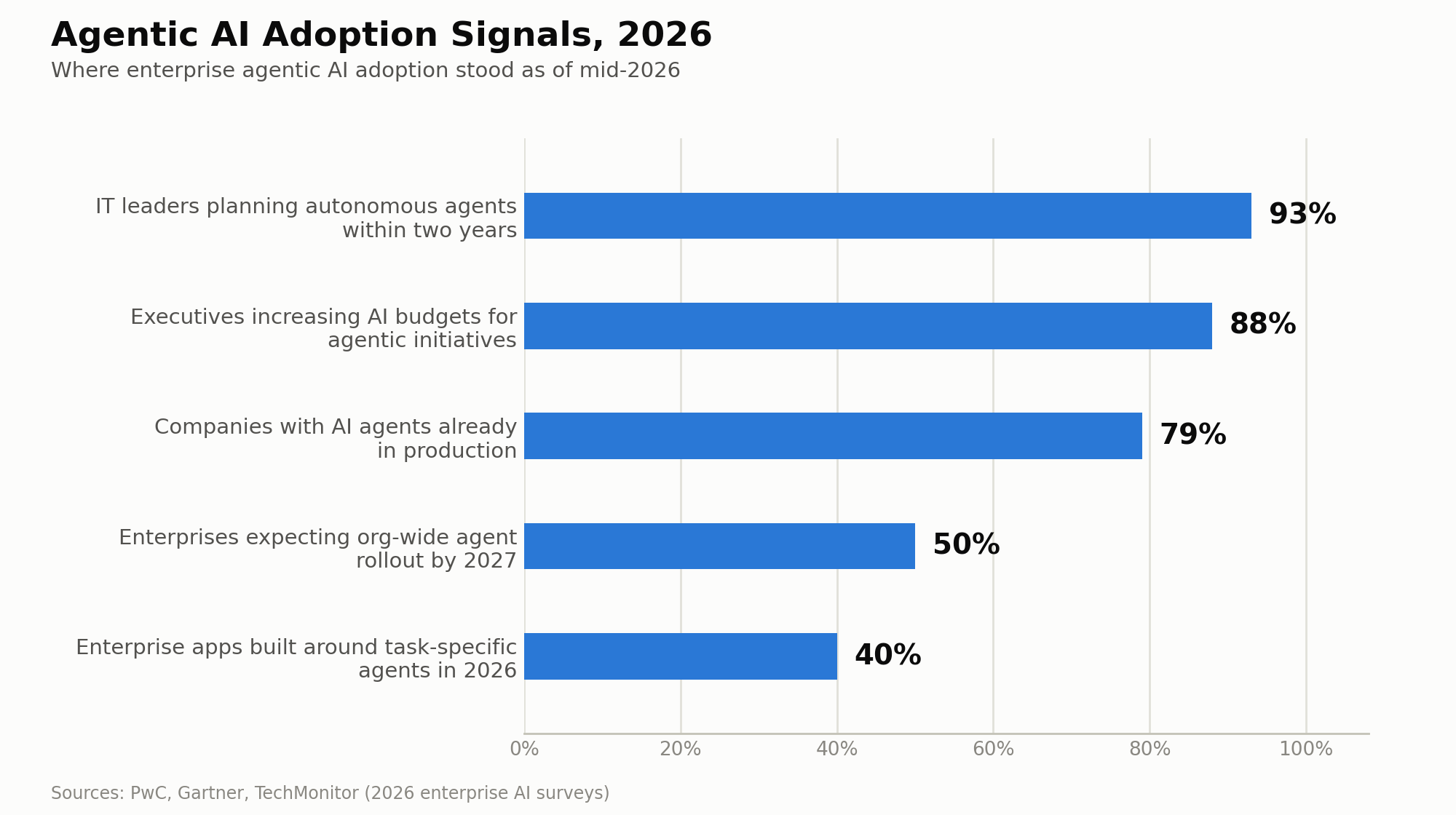
The productivity data supports the budget commitment. PwC found that 66% of companies using AI agents report measurable productivity gains, with more than half reporting faster decision-making and improved customer experience as a direct result. For an ecommerce operation, that translates into agents handling inventory reconciliation and customer service triage. It also means personalized product recommendations running without a person initiating every step. Half of enterprises already running generative AI expect to deploy autonomous agents organization-wide by 2027. That number sets up the forecast later in this piece: 2026 built the infrastructure, and 2027 is where agentic AI gets tested at full operational scale.
Smaller, Specialized Models Started Taking Real Share
Small, specialized models built a measurable cost case in 2026. Running 100 million tokens a day through a self-hosted Phi-4 model costs about $50 daily on a rented A100 GPU. Routing that same volume through a frontier API like Claude Sonnet costs about $1,560 a day for equivalent throughput, per cost analysis published by Practical Logix. Annualized, self-hosted Phi-4 runs about $18,000 a year at that volume. The frontier API route runs about $570,000 a year at the same volume. Hybrid architectures that pair a small model with a frontier model for the hardest queries cut total costs by 70% to 90% relative to a frontier-only setup.
The catch is scale. Those savings only materialize above roughly 50 million tokens a day per workload. Below that threshold, the operational complexity of self-hosting outweighs the unit-cost savings, which is the practical answer to the SLM vs LLM question for most mid-sized businesses: it depends entirely on volume, not on which model is technically superior.
Enterprise AI spending kept climbing even as per-token prices fell by close to 280 times since late 2022, rising from an average of $1.2 million annually in 2024 to $7 million in 2026. Companies scaled usage faster than prices fell. Specialized models are absorbing more of that expanded spending. Microsoft's Phi-4 scored 80.4% on the MATH benchmark this year, ahead of GPT-4o's 74.6%, a result that explains why open source and small model options now appear as standard items in enterprise AI roadmap conversations.
Multimodal Became the Default Way People Use AI
ChatGPT's weekly active users nearly doubled in the past year, moving from about 400 million in February 2025 to about 800 million by the end of 2025, per Fast Company's reporting. Over half of consumers, 53%, say they have tried generative AI directly. Search interest in the term "AI agent" tripled over the past year, and traffic from AI engines to retail sites grew 4,700% year over year as of mid-2025, a trend that carried directly into 2026 ecommerce data.
Voice, image, and video inputs and outputs became standard features across major consumer and enterprise AI products through 2026. For an ecommerce brand, this shows up in visual search adoption and AI-generated video product content, alongside voice-driven customer service tools already live in production. Multimodal capability became a checkout-page feature in 2026. Brands that built it into product discovery early are already capturing a meaningful share of traffic from AI answer engines and AI-referred shoppers.
Regulation Caught Up: The EU AI Act's August 2026 Deadline
The EU AI Act's core obligations for high-risk systems became enforceable on August 2, 2026, according to legal analysis from Holland & Knight. High-risk systems include those used for biometric identification, credit and insurance decisions, employment screening, critical infrastructure, and law enforcement. Providers placing these systems on the market must complete conformity assessments, prepare technical documentation, register the system in the EU database, and appoint an authorized EU representative. Companies deploying these systems must assign human oversight and retain automated logs for six months. They must also notify people affected by the system's decisions.
Penalties reach 15 million euros or 3% of global annual turnover, whichever is larger, plus the possibility of a forced market withdrawal. The law applies based on where an AI system's output is used, not where the company issuing it is based, which means an ecommerce brand selling into the EU falls under this regulation regardless of where its headquarters or its AI vendor sits.
The European Parliament voted to push some of these deadlines to December 2027, with sector-specific obligations moving to August 2028, but that delay needs Council approval before it takes legal effect. Until it does, the August 2026 obligations stand. Any business running AI-driven personalization, credit scoring, or hiring tools that touch EU customers should treat this deadline as active today.
What the Jobs Numbers Actually Show
AI-tied job cuts totaled 10,375 in 2025 according to Challenger, Gray & Christmas, with a broader estimate of 76,440 positions eliminated due to early AI adoption across the same year, per SSRN research. Clerical and administrative roles carry the highest concentration of risk, with Brookings estimating 6.1 million U.S. workers in high-exposure positions. Customer service roles face an estimated 80% automation risk across about 2.8 million jobs, and Bloomberg Intelligence estimates up to 200,000 Wall Street roles could be cut over the same period.
The same research points to significant job creation running alongside these losses. One widely cited World Economic Forum projection puts global job displacement at 92 million by 2030 against 170 million new roles created in the same window, a net gain of 78 million positions worldwide. Veritone data shows AI-specific job openings grew 25.2% year over year in early 2025.
These numbers describe disruption concentrated in specific job functions across the labor market. The businesses managing this well in 2026 are the ones retraining staff into the roles AI creates around it: prompt design and agent oversight, work that did not exist three years ago.
Is the AI Investment Story Overheating?
Major cloud providers, Amazon, Alphabet, Meta, and Microsoft, are on pace to spend a combined $760 billion on data center investment in 2026, up from $413 billion in 2025. Global AI spending is projected to reach $2.52 trillion in 2026, a 44% increase year over year, according to Gartner. AI infrastructure accounts for the largest share at $1.366 trillion, 54% of the total.
Broadcom's price-to-sales ratio came within striking distance of 30 in 2025, reaching 27.97 in October, while Nvidia's peaked lower, at 27.69 in January 2024, before easing to about 22 by January 2026. The top ten stocks in the S&P 500 represented nearly 41% of the index's total weight by the end of 2025, compared with roughly 27% at the dot-com era's peak in 2000. Rockefeller International's Ruchir Sharma has said rising interest rates are what would burst the AI bubble, and has flagged 2026 as the window where that risk is most live.
The AI bubble debate is not close to resolved, and the capital flowing into AI infrastructure is now large enough, and concentrated enough, that a correction would ripple through far more of the economy than it would have two years ago. Businesses building on top of major AI platforms should plan for vendor pricing and roadmap volatility as a normal part of operating risk heading into 2027.
How Close Is AGI, Really?
Forecaster timelines on artificial general intelligence have moved in identifiable waves since 2023, tracked by researchers including Daniel Kokotajlo and Eli Lifland of the AI Futures Project, alongside independent forecasters like Peter Wildeford of the Institute for AI Policy and Strategy.
No consensus date exists for when artificial general intelligence arrives, and any source claiming certainty on this is overstating what the research supports. What the data shows clearly is direction: the people paid to forecast this professionally spent early 2026 revising their timelines earlier. That direction matters more for planning purposes than any specific year, because it signals how fast the frontier labs themselves believe their own trajectory is moving.
The 2027 Outlook: What to Watch Next
Agentic AI deployment moves from department-level pilots toward full organizational rollout in 2027, building directly on the momentum already visible in this year's adoption numbers. The agentic commerce piece of that trajectory is specific to ecommerce. AI shopping agents are completing purchases on a customer's behalf, and checkout flows increasingly need to work for machine buyers as well as human ones. Product data has to be structured so an AI agent can find and transact with a brand without a person clicking through five pages first. About a third of consumers already say they would let an AI agent complete a purchase for them.
Regulatory enforcement adds more complexity heading into 2027. The EU AI Act's higher-risk obligations remain scheduled to expand into December 2027 and August 2028 pending Council approval of the current delay proposal, which means compliance planning for 2027 needs to account for both the deadlines currently in force and the ones sitting in legislative limbo.
The AI investment story faces its clearest test yet in 2027. Capital expenditure at this scale, over $2.5 trillion globally in 2026 alone, cannot keep compounding at 44% annual growth indefinitely without matching revenue growth showing up somewhere in the economy. That gap is the single most consequential open question for anyone planning AI-dependent infrastructure spending past this year.
AGI timeline forecasts will likely keep moving. Businesses should plan around the direction of that movement. A forecaster community that spent early 2026 revising toward sooner timelines is likely to keep revising in that direction.
What This Means for Ecommerce Brands
Every trend covered here lands on the same operational surface for an ecommerce business: the site, the checkout, the product data, and the systems connecting them. Agentic AI adoption among surveyed companies means competitors are already routing customer service, inventory decisions, and personalization through agents while some brands are still deciding whether to run a pilot. Multimodal search and AI-referred shopping traffic are growing fast enough that product pages built only for human eyes and human search behavior are leaving revenue on the table right now. Regulatory obligations under the EU AI Act apply to any brand selling into the EU regardless of where its AI vendor is based, which makes this a technical and legal question that ecommerce leadership needs to own directly.
Getting that infrastructure right, the platform, the product data, the checkout, is what Arctic Leaf does for ecommerce brands day to day: custom builds, UX and conversion rate work, and the email programs that keep new traffic converting once it arrives.
Most of the trends covered here are already active on your own site right now. Arctic Leaf runs a free AI audit that shows where your content, product data, and search visibility are working with AI systems and where they are falling short, plus a prioritized list of what to fix first.