Customer Lifecycle Mapping: Turning First Purchases Into Loyalty
Key Takeaways from the Blog Post
-
Retention begins long before someone decides to leave and is shaped by every interaction after checkout.
-
Product adoption, onboarding, and habit formation often have a greater impact on loyalty than promotional incentives.
-
Behavioral insights help ecommerce brands create more relevant experiences throughout the customer lifecycle journey.
-
Advocacy grows from trust built over time, creating opportunities for referrals, reviews, and organic growth.
-
A well-defined lifecycle marketing strategy helps teams align retention, engagement, and revenue goals.
Customer Lifecycle Mapping
Turning First Purchases Into Loyalty
Ecommerce teams spend enormous time analyzing acquisition. They know which campaigns drive traffic, which channels produce the best return on ad spend, and which landing pages convert. Far fewer can explain what happens after.
That's a significant blind spot. A steady flow of new visitors can make a business look healthy while rising acquisition costs and declining retention quietly erode it underneath. The first sale marks the start of a connection that will either deepen or quietly disappear.
Customer lifecycle mapping examines the progression from an initial order to repeat purchasing, subscription participation, advocacy, or disengagement. It helps teams identify which interactions influence those outcomes and where opportunities exist to strengthen long-term performance. The Pareto principle offers a useful reminder of why this matters: roughly 20% of buyers tend to account for the majority of revenue, making retention one of the most important drivers of profitability. Most ecommerce leaders understand this concept in theory. The framework provides a practical way to apply it.
Why One-Time Buyers Create Long-Term Problems
Many ecommerce businesses get trapped in a cycle of replacement.
Every month starts with the need to attract another wave of shoppers because too many previous buyers never returned. New orders keep arriving, but they depend increasingly on paid acquisition, promotions, and constant outreach. Revenue grows while profitability becomes harder to maintain.
This pattern is especially dangerous because it can remain hidden for a long time. A strong advertising programme can mask weak retention. Seasonal demand can disguise declining engagement. Promotions can temporarily lift revenue without addressing the underlying issue. Eventually, the economics become impossible to ignore.
As acquisition costs rise, the value of retention becomes harder to dismiss. A company generating consistent repeat business can grow more efficiently because each new buyer represents more than a single transaction. Future purchases, referrals, reviews, community participation, and advocacy all become possible when trust continues beyond the initial sale. None of those outcomes occur automatically.
A first purchase creates potential. What happens next determines whether that potential develops into something worth keeping.
The Critical Moments Most Brands Overlook
When ecommerce teams discuss retention, conversations usually focus on email marketing, loyalty programmes, or promotional offers. Many long-term outcomes, however, are influenced much earlier, during the period immediately following checkout, a stage many businesses place on autopilot.
At this point, buyers are evaluating the decision itself, not simply the item they ordered. Confidence encourages continued engagement. Uncertainty encourages second-guessing. Businesses have direct control over this process, and the decisions made during this period often shape the broader customer experience long before a second purchase is considered. A shipping confirmation with a realistic delivery window removes anxiety. An onboarding email explaining how to use an item builds confidence before requesting a review. A support response delivered within hours demonstrates attentiveness and accountability. None of these actions require additional technology or budget. They require treating the post-purchase period as a sequence worth designing rather than a collection of default notifications.
Many organizations struggle here because responsibility is fragmented. Confirmation emails are written once and forgotten. Shipping updates remain unchanged for years. Support interactions are measured primarily by ticket closure. Each represents a missed opportunity to reinforce confidence and strengthen trust.
Trust rarely comes from a single moment. It develops through a series of interactions consistently meeting expectations, removing friction, and reinforcing the decision made only moments earlier.
Product Adoption Matters More Than Most Retention Campaigns
One of the biggest mistakes in ecommerce is treating a transaction as the end of the story. For many categories, it marks the beginning, and the first week often determines whether another order ever follows.
A skincare company whose audience sees results after six weeks needs to communicate that clearly. Someone expecting overnight change and seeing none by day ten may conclude the formula doesn't work and quietly stop using it. A supplement business selling something requiring daily consistency benefits from a check-in at day three or four, before the habit breaks, instead of a generic 'how's it going?' email arriving a month later. A software platform with a fifteen-minute setup process needs users completing setup immediately. Every day it remains unfinished increases the likelihood of cancellation.
None of this fits neatly into traditional marketing.
An automated post-purchase flow differs from a sequence built around specific points where value fails to materialize. Misuse, inconsistency, skipped setup steps, and unclear instructions create frustration long before support teams hear about it.
Several practical questions deserve attention. Which information is needed during the first 48 hours? Why do people abandon the process before seeing results? Is there a critical setup step? Has it been completed? If something is being used incorrectly, can the issue be identified before disengagement occurs?
A company selling cast iron cookware provides a simple example. Including a one-page seasoning guide can prevent rust, sticking, and unnecessary frustration. The cookware itself remains unchanged. Outcomes improve once people understand proper usage. One sheet of paper can influence repeat business more significantly than another promotional campaign, since it addresses a predictable source of disappointment.
Specificity drives retention. Generic onboarding rarely changes behaviour. Identifying the one or two obstacles most likely to prevent success often does.
Moving From Satisfaction to Habit
Satisfaction matters, but it does not automatically create loyalty. Plenty of people enjoy what they buy, leave a positive review, and never return. Nothing went wrong. There simply was no compelling reason to come back.
Habit changes the equation.
Once an item becomes part of a routine, future purchases become far more likely. Coffee, supplements, pet supplies, beauty products, and household essentials provide obvious examples, although the principle extends well beyond those categories.
The shift from satisfaction to habit depends on three variables every business can track:
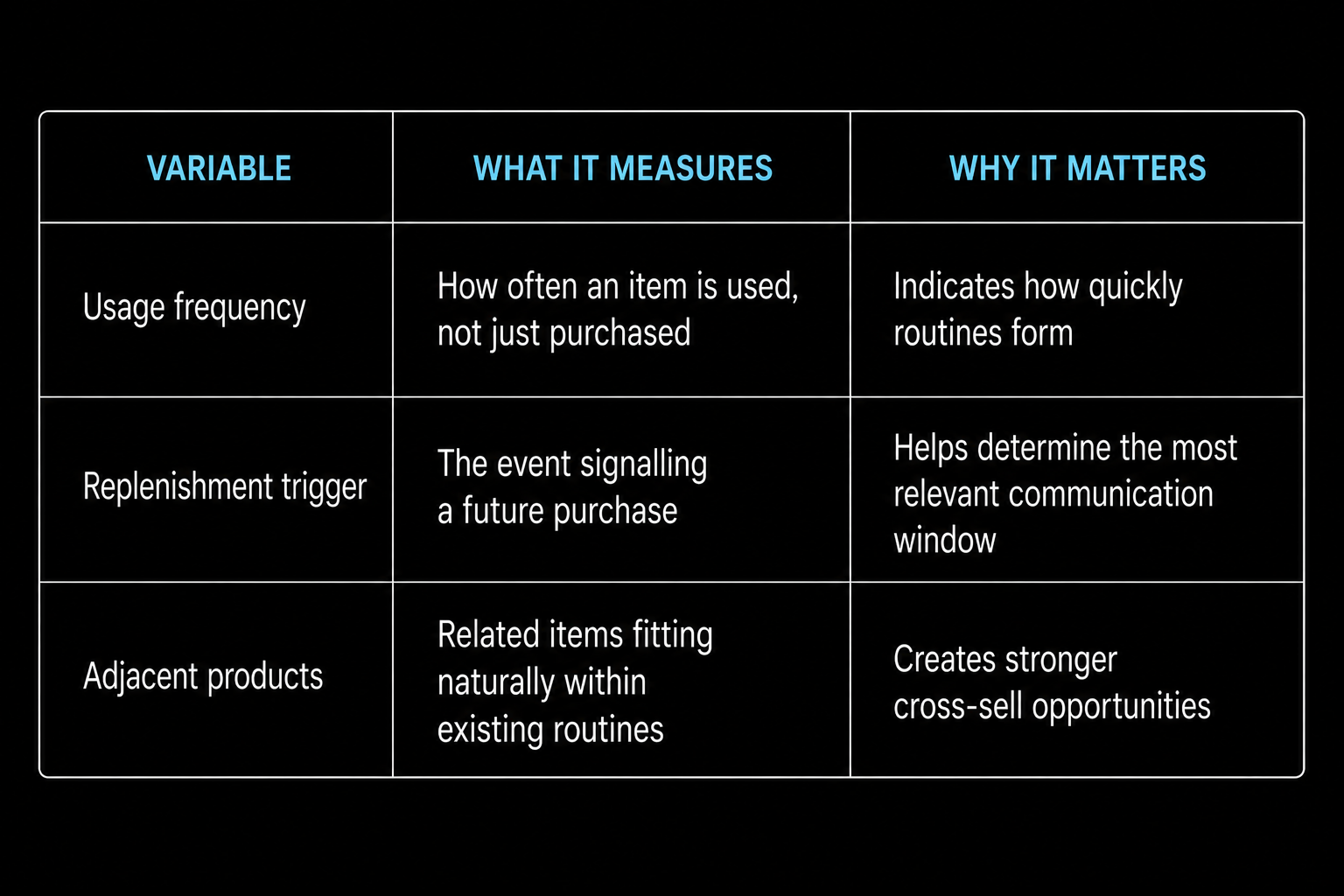
Strong operators track these variables deliberately. They understand usage frequency, replenishment triggers, and which complementary items fit naturally within existing routines. This knowledge allows communication to align with real behaviour instead of assumptions. Timing becomes easier once these patterns are understood.
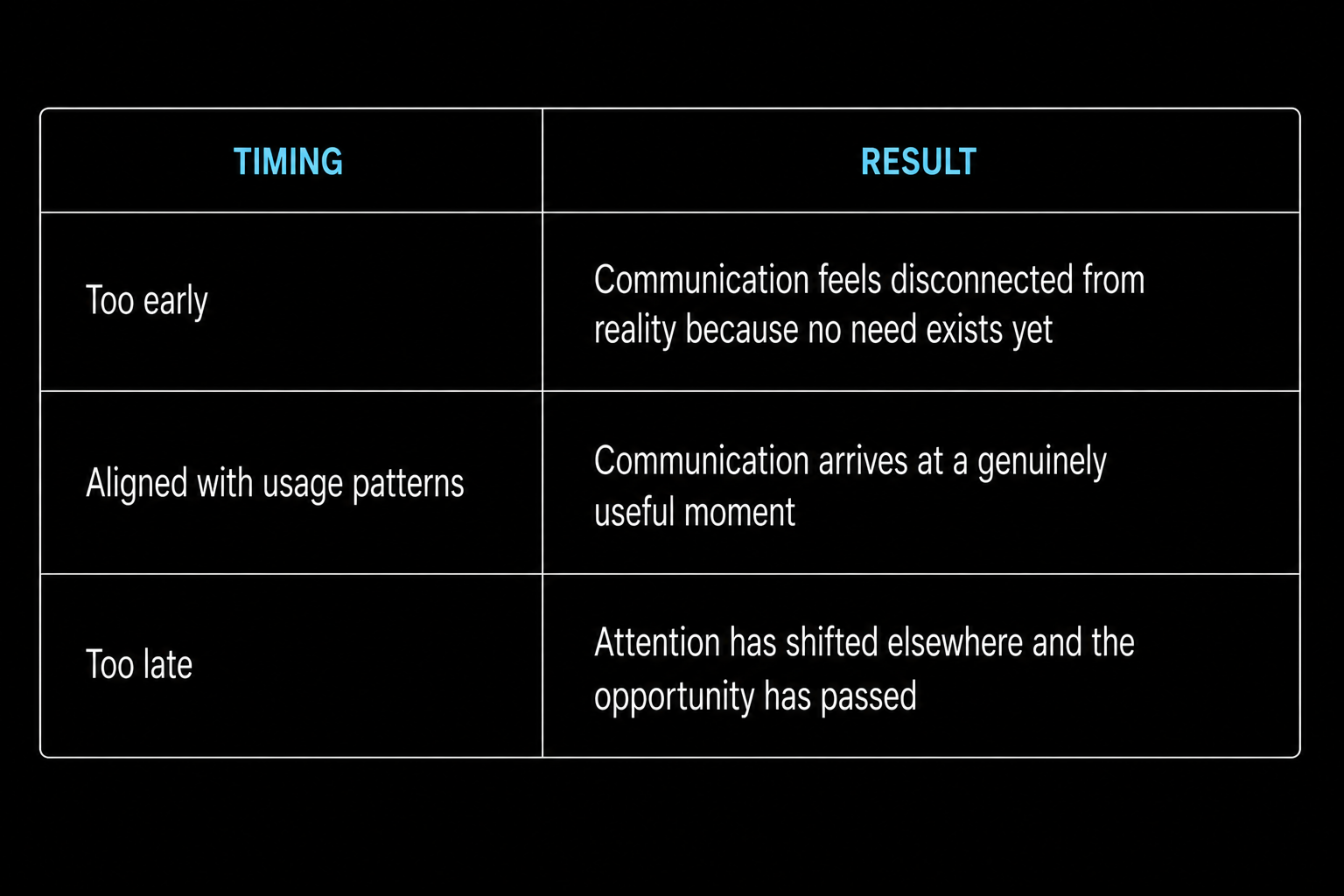
Strong lifecycle strategies align communication with genuine needs and usage patterns instead of arbitrary marketing calendars. The result feels helpful instead of intrusive.
Why Behavioural Data Creates Better Experiences
Personalisation remains one of the most discussed topics in ecommerce, yet numerous implementations remain surprisingly shallow.
Adding a first name to a subject line is not personalisation. Neither is inserting a generic recommendation block into an email. Consumers recognize the difference immediately, and the data reflects it. Retailers frequently believe they excel at personalisation. Significantly fewer shoppers agree.
Meaningful personalisation starts with understanding behaviour. Browsing activity highlights interests. Purchase history reveals preferences. Reviews provide insight into satisfaction. Support interactions uncover recurring sources of friction. Loyalty programme participation often signals deeper involvement. Collectively, these signals create a far richer understanding than demographic information alone.
Real value emerges once those insights influence decisions instead of simply filling a database. The strongest personalisation programs improve the customer experience by making interactions feel relevant, timely, and informed by actual behaviour.
A premium-focused shopper may respond differently to merchandising than someone primarily motivated by promotions. Subscribers often prioritize convenience and predictability. Highly engaged advocates may care more about early access, exclusive launches, or community participation than discounts.
The goal is relevance.
People notice recommendations aligned with their interests. They also notice messages feeling identical regardless of browsing behaviour, purchase history, or previous interactions. That disconnect carries a measurable cost. Product recommendations generate a substantial share of ecommerce revenue despite representing only a small portion of site traffic, highlighting how much opportunity remains once personalisation moves beyond surface-level tactics.
The framework helps teams organize behavioural insights as actions creating more relevant interactions over time.
Recognition Is Often More Powerful Than Rewards
Many loyalty initiatives lean heavily on incentives.
Points, discounts, and rewards can influence behaviour, but they represent only one part of the equation. Long-term loyalty often develops because people feel recognized, understood, and valued. A discount code can encourage another purchase. Recognition creates a stronger emotional connection.
Recognition takes many forms: personalized recommendations, early access to new products, thoughtful communication, exclusive content, community participation, or membership benefits offering genuine value. Their impact comes from reinforcing familiarity and appreciation over time.
Sephora's Beauty Insider programme provides a useful example. Members earn points for purchases and can redeem those points for products. The structure includes three tiers, beginning with a free entry-level membership and progressing through increasingly exclusive levels tied to annual spending.
On paper, the programme looks fairly straightforward.
The deeper appeal comes from access and status. Higher tiers receive invitations to private events, workshops, and product launches before the general public. Those benefits have little to do with discounts. They create a sense of belonging and exclusivity.
A top-tier member is not spending $1,000 annually simply because the redemption math works in their favour. The value comes from participation, recognition, and status. Sephora's leadership has openly discussed balancing transactional rewards with emotional rewards. Exclusivity plays an important role because access feels earned rather than automatically granted.
People gravitate toward businesses acknowledging participation and loyalty. This explains why successful programmes frequently combine status, access, community, and financial incentives. Discounts may encourage another purchase. Recognition creates attachment.
The strongest programmes combine both approaches within a broader strategy designed to strengthen affinity over time.
The framework helps identify opportunities for recognition and reveals where they fit naturally. A sophisticated tier structure is one option. Smaller businesses can achieve similar outcomes through early access, exclusive content, community initiatives, or personalized communication.
Advocacy Is Earned Long Before Someone Leaves a Review
Reviews, referrals, testimonials, and user-generated content are often treated as outcomes. In reality, they signal a deeper level of trust and confidence.
Recommendations rarely come from indifference.
People associate their own reputation with businesses they recommend. That decision requires confidence, and confidence develops gradually through positive interactions accumulated over time.
Timing plays a major role.
A person receiving a product last week may not have enough familiarity to provide meaningful feedback. Someone returning repeatedly over several months is far more likely to leave a thoughtful review or recommend the business to friends and family. The same principle applies to referral programmes and user-generated content initiatives. Success depends less on programme mechanics and more on goodwill established long before anyone asks for participation.
Understanding these patterns makes advocacy easier to encourage. Review requests, referral campaigns, and community initiatives perform best when enthusiasm is strongest rather than immediately following delivery.
Creating a Lifecycle Framework That Teams Actually Use
One of the biggest mistakes organisations make is treating lifecycle mapping as a one-time exercise. A diagram gets created, a workshop takes place, a presentation is delivered, and then the document sits untouched while everyone returns to their normal routines.
A useful framework does the opposite. It becomes part of regular decision-making across the business.
That only happens once responsibilities are clearly understood.
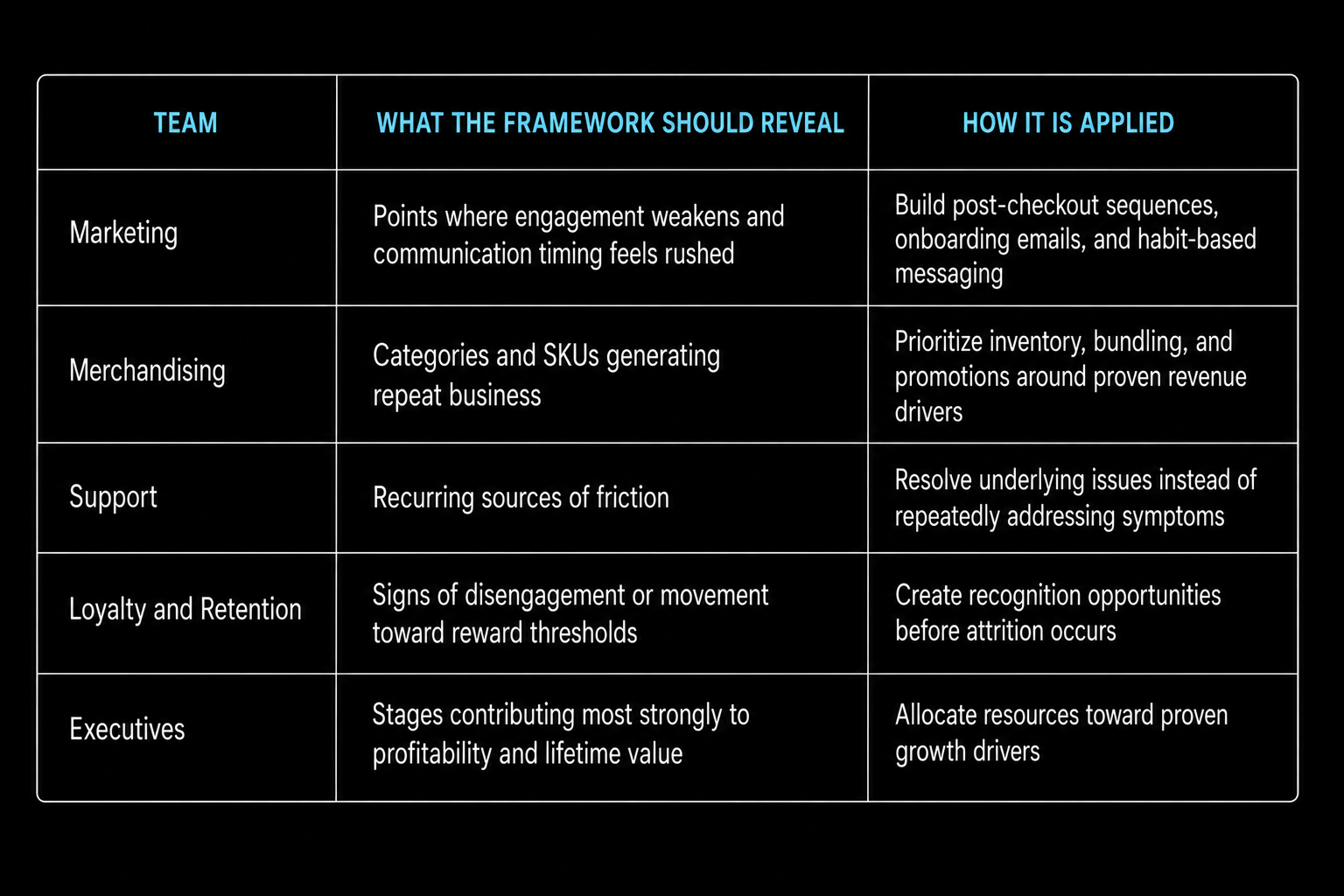
Every section discussed here, including post-checkout communication, adoption, habit formation, personalisation, recognition, and advocacy, belongs within the same framework. None of these elements operate effectively in isolation.
Someone enjoying a smooth first two weeks but never adopting the product is still likely to disengage. A person achieving success but receiving little recognition may leave a positive review without becoming an advocate. Long-term performance improves when these stages work together rather than existing as disconnected initiatives.
The purpose is developing a clearer understanding of how loyalty develops, who owns each stage, and which actions contribute most strongly to growth.
Turning Insight Into Sustainable Growth
Customer lifecycle mapping is ultimately about understanding how trust develops over time and identifying the interactions influencing future behaviour. Businesses excelling at retention rarely depend on a single tactic. They focus on creating consistent value, reducing friction, and helping people achieve the outcomes motivating the original purchase.
Through custom ecommerce design and development, web and mobile solutions, UX design, CRO, software development, and email marketing, we help businesses create stronger customer experiences that support sustainable growth and stronger retention. When strategy, technology, user experience, and lifecycle initiatives work together, an initial transaction becomes something far more valuable: the beginning of long-term trust, continued relevance, and lasting loyalty.
FAQ
What is customer lifecycle mapping for ecommerce?
Customer lifecycle mapping for ecommerce is the process of documenting how people interact with a business from initial discovery through repeat purchasing, advocacy, and re-engagement. The goal is to identify opportunities to improve experiences at every customer lifecycle stage while building a clearer picture of what drives long-term retention, lifetime value, and sustainable revenue growth.
What is the difference between a customer journey map and customer lifecycle management?
A customer journey map focuses on individual interactions across specific touchpoints. Customer lifecycle management takes a broader view of the entire connection over time, covering acquisition, onboarding, engagement, retention, advocacy, and reactivation. Many ecommerce businesses use both approaches: a customer journey map reveals friction within specific interactions, while customer lifecycle management helps teams understand the larger progression. This broader perspective often creates stronger alignment between retention goals, operational priorities, and overall marketing performance.
How does customer journey mapping improve retention?
Customer journey mapping helps ecommerce teams identify friction points that may prevent someone from returning after an initial purchase. By examining interactions across websites, email, support channels, account areas, and post-purchase communications, businesses gain a clearer picture of where expectations are being met and where improvements are needed. Strong customer journey mapping often uncovers opportunities contributing directly to higher retention, stronger lifetime value, and more effective marketing.
What is a customer lifecycle journey?
A customer lifecycle journey describes the full progression from initial awareness through advocacy. Unlike a transaction-focused view, a customer lifecycle journey examines how trust, preferences, and purchasing behaviour evolve over time. Understanding this progression allows ecommerce companies to build more relevant interactions throughout every phase and develop a stronger lifecycle marketing strategy around retention, engagement, advocacy, and long-term growth.
Why is customer lifecycle management important for ecommerce brands?
Customer lifecycle management helps organizations understand which interactions contribute most strongly to retention, engagement, and long-term revenue generation. Rather than focusing exclusively on acquisition, customer lifecycle management provides a framework for improving onboarding, encouraging repeat purchases, strengthening loyalty, and identifying disengagement before relationships are lost. It also supports more informed decision-making across marketing, merchandising, support, and product teams while helping align broader marketing efforts with retention goals.
How does lifecycle marketing fit into a customer lifecycle journey?
Lifecycle marketing focuses on delivering relevant communication based on where someone exists within a customer lifecycle journey. Instead of sending identical messages to every segment, businesses can tailor content, offers, recommendations, and educational resources according to behaviour, engagement history, and relationship maturity. This approach creates more meaningful interactions while helping marketing remain relevant throughout the lifecycle.
What role does customer success play in retention?
Customer success focuses on helping people achieve the outcomes they expected when making a purchase. Whether through onboarding, education, support resources, or proactive guidance, customer success initiatives reduce friction and improve adoption. People achieving meaningful results are more likely to continue engaging, respond positively to future marketing communications, and progress into the next lifecycle stage.
How do businesses use a customer journey map alongside a customer lifecycle journey?
A customer journey map helps teams understand specific interactions and touchpoints, while a customer lifecycle journey provides a broader view of how connections develop over time. Together, these frameworks help organizations identify opportunities to improve experiences, strengthen retention, and support movement from one lifecycle stage to another. Many companies maintain multiple customer journey map exercises for different audience segments while managing the overall customer lifecycle journey through a unified retention and marketing framework.
What metrics should be used to evaluate lifecycle performance?
Common metrics include customer lifetime value, retention rate, repeat purchase rate, engagement levels, referral activity, loyalty participation, and progression through each customer lifecycle stage. Many ecommerce teams use platforms such as Google Analytics alongside CRM, attribution, and marketing automation tools to understand how engagement patterns change over time, measure the effectiveness of marketing initiatives, and identify opportunities for improvement.